Jainism (pronounced /ˈdʒeɪnɪzəm/) is an ancient religion of India that prescribes a path of non-violence towards all living beings. Its philosophy and practice rely mainly on self-effort to progress the soul up the spiritual ladder to divine consciousness. Any soul that has conquered its own inner enemies and achieved the state of supreme being is called 'Jina' (Conqueror or Victor). Jainism is also referred to as Shraman (self-reliant) Dharma or the religion of Nirgantha (who does not have attachments and aversions) by ancient texts. It is referred to in Kannada ಜೈನಧರ್ಮ, Hindi जैनधर्म (Jain Dharma) and in Tamil சமணம்(Samanam). Jainism was revived by a lineage of 24 enlightened ascetic leaders called Tirthankaras[1] culminating with Parshva (9th century BC) and Mahavira (6th century BC).[2][3][4][5][6] In the modern world, it is a small but influential religious minority with as many as 4.2 million followers in India,[7] and successful growing immigrant communities in North America, Western Europe, the Far East, Australia and elsewhere.[8] Jains successfully sustained this ancient religion to this era and have significantly influenced and contributed to ethical, political and economic spheres in India. Jains have an ancient tradition of scholarship and have the highest degree of literacy in India;[9][10] Jain libraries are the oldest in the country.[11] Tamil Jains and Kannada/Tulu Jains who are native to their region residing in places Tamil Nadu,Karnataka and some parts of Kerala respectively early since 1st century BC are distinguishable in some of their routines and practices from North Indian Jains, but the core philosophies and belief systems are the same for both cultures. Principles and other beliefsSee also: Mahavrata Jainism regards every living soul as potentially divine. The goal of Jainism is to realize the soul's true nature. When the soul sheds its karmic bonds completely, it attains divine consciousness. Jainism prescribes a path of non-violence to progress the soul to this ultimate goal.
Jainism encourages spiritual development through cultivation of one's own personal wisdom and reliance on self-control (व्रत, vrata).[23] Right perception, Right knowledge and Right conduct ( triple gems of Jainism) provide the path for attaining liberation (moksha) from the cycles of birth and death (samsara). Moksha is attained by liberation from all karma. Those who have attained moksha are called siddha (liberated souls), and those who are attached to the world through their karma are called samsarin (mundane souls). Every soul has to follow the path, as explained by the Jinas and revived by Tirthankaras, to attain the complete liberation. Jains hold that the Universe and its laws of nature are eternal, without beginning or end. However, the universe constantly undergoes cyclical changes. The universe is occupied by both living beings ("Jīva") and non-living objects ("Ajīva"). The samsarin (worldly or mundane) soul incarnates in various life forms during its journey over time. Human, sub-human (animal, insect, plant, etc.), super-human (heavenly being), and hell-being are the four macro forms of the samsari souls. All worldly relations of one's soul with other souls and non-living objects and the thoughts, expressions and actions give rise to accumulation of karma in the past and present. And these in turn feedback to determine our current circumstances that are both rewarding and punishing. Jain scholars have explained in depth on techniques that will clear the past karmas accumulated as well as stopping the influx of fresh karmas. The main Jain prayer (navkar Mantra) therefore salutes the five special categories of souls that have attained divine consciousness or are on their way to achieving it, so as to emulate them and follow their path to salvation. Another major characteristic of Jain belief is the emphasis on the consequences of not only physical but also mental behaviours.[24] The principle of non-violence seeks to minimize karmas which may limit the capabilities of the soul. Jainism views every soul as worthy of respect because it has the potential to become Siddha (Param-atma - "highest soul"). Because all living beings possess a soul, great care and awareness is essential in one's actions. Jainism emphasizes the equality of all life, advocating harmlessness towards all, whether the creatures are great or small. This policy extends even to microscopic organisms. Jainism acknowledges that every person has different capabilities and capacities to practice and therefore accepts different level of compliance for ascetics and householders. The "great vows" (mahavrata) are prescribed for monks and "limited vows" (anuvrata) are prescribed for householders. [edit] |
||||||||||||||||||||||||||||||||||||||||||
| Details | Alternate name: |
Vardhamana | Historical date: |
599 – 527 BCE |
| Father: |
Siddharatha | Mother: |
Trishala (Priyakarni) | Dynasty: |
Ikshvaku |
| Birth: |
Kundalagrama near Vaishali | Nirvana: |
Pavapuri |
| Colour: |
Yellow | Symbol: |
Lion | Height: |
6 Feet | Age At Death: |
72 years old |
| Yaksha: |
Matang | Yaksini: |
Siddhayika | 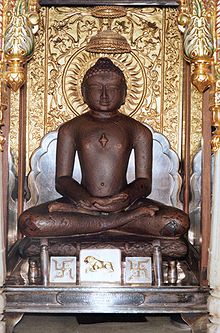 |
Mahavira (महावीर lit. "Great Hero", traditionally 599 – 527 BCE[1] is the name most commonly used to refer to the Indian sage Vardhamana (Sanskrit: वर्धमान "increasing") who established what are today considered to be the central tenets of Jainism. According to Jain tradition, he was the 24th and the last Tirthankara. He is also known in texts as Vira or Viraprabhu, ...Sanmati, Ativira,and Gnatputra. In the Buddhist Pali Canon, he is referred to as Nigantha Nātaputta In a place called Kshatriyakunda in the ancient kingdom of Lachuar in Jamui District in modern day Bihar, India, Mahavira was born to King Siddartha and Queen Trishala on the 13th day under the rising moon of Chaitra (12 April according to the Gregorian calendar). While still in his mother's womb it is believed he brought wealth and prosperity to the entire kingdom, which is why he was also known as Vardhaman. An increase of all good things, like the abundant bloom of beautiful flowers, was noticed in the kingdom after his conception. Queen Trishala had 14 (14 in Swetambar Sect, 16 in Digambar Sect) auspicious dreams before giving birth to Vardhaman, signs foretelling the advent of a great soul. Jain tradition states that after his birth, Indra bathed him in celestial milk with rituals befitting a future Tirthankar and he was returned to his mother, Trishala. Vardhaman's birthday is celebrated as Mahavir Jayanti, the most important religious holiday of Jains around the world As King Siddartha's son, he lived as a prince. However, even at that tender age he exhibited a virtuous nature. He started engaging in meditation and immersed himself in self-contemplation. He was interested in the core beliefs of Jainism and began to distance himself from worldly matters India at the time of Mahavira At the age of thirty Mahavira renounced his kingdom and family, gave up his worldly possessions, and spent twelve years as an ascetic. During these twelve years he spent most of his time meditating. He gave utmost regard to other living beings, including humans, animals and plants, and avoided harming them. He had given up all worldly possessions including his clothes, and lived an extremely austere life. He exhibited exemplary control over his senses while enduring the penance during these years. His courage and braveness earned him the name Mahavira. These were the golden years of his spiritual journey, at the end of which he achieved Kaivlya Gyan. He was now a person of infinite harmony, knowledge and self-control Mahavira devoted the rest of his life to preaching the eternal truth of spiritual freedom to people around India. He traveled barefoot and without clothes, in the hardest of climates, and people from all walks of life came to listen to his message. At one point Mahavira had over 400,000 followers. Mahavira's preaching and efforts to spread Jain philosophy is considered the real catalyst to the spread of this ancient religion throughout India and into the mainstream. At the age of 72 years and 4.5 months, he attained Nirvana in the area known as Pawapuri on the last day of the Indian and Jain calendars, Dipavali. Jains celebrate this as the day he attained liberation or Moksha. Jains believe Mahavira lived from 599-527 BCE, though some scholars prefer 549-477 BCE Mahavira's philosophy has eight cardinal principals – three metaphysical and five ethical. The objective is to elevate the quality of life. Mahavira preached that from eternity, every living being (soul) is in bondage to karmic atoms accumulated by good or bad deeds. In a state of karmic delusion, the individual seeks temporary and illusory pleasure in material possessions, which are the root causes of self-centered violent thoughts and deeds as well as anger, hatred, greed, and other vices. These result in further accumulation of karma. To liberate one's self, Mahavira taught the necessity of right faith (samyak-darshana), right knowledge (samyak-gyana), and right conduct (samyak-charitra'). At the heart of right conduct for Jains lie the five great vows:
These vows cannot be fully implemented without accepting the philosophy of non-absolutism (Anekantvada) and the theory of relativity (Syādvāda, also translated "qualified prediction"). Monks and nuns adhere strictly to these vows, while the laypeople observe them as best they can. Mahavira taught that men and women are spiritual equals and that both may renounce the world in search of moksh or ultimate happiness. Mahavira attracted people from all walks of life, rich and poor, men and women, touchable and untouchable. He organized his followers into a fourfold order; monk (Sadhu), nun (Sadhvi), layman (Shravak), and laywoman (Shravika). This order is known as Chaturvidh Jain Sangh. Mahavira's sermons were preserved orally by his immediate disciples in the Agam Sutras. Through time many Agam Sutras have been lost, destroyed, or modified. About one thousand years after Mahavira's time the Agam Sutras were recorded on Tadpatris (palm leaf paper used then to form books). Swetambar Jains accept these sutras as authentic teachings while Digambar Jains use them as a reference. Jainism existed before Mahavir, and his teachings were based on those of his predecessors. Thus Mahavira was a reformer and propagator of an existing religion, rather than the founder of a new faith. He followed the well established creed of his predecessor Tirthankar Parshvanath. However, Mahavira did reorganize the philosophical tenets of Jainism to correspond to his times. A few centuries after Mahavira's Nirvana, the Jain religious order (Sangh) grew more and more complex. There were schisms on minor points, although they did not affect Mahavira's original doctrines. Later generations saw the introduction of rituals and complexities that some criticize as placing Mahavira and other Tirthankars on the throne similar to those of Hindu deities. |
||||||||||
Make a Free Website with Yola.
